Parfait Munyemana tells Biénne Huisman how he ironed his own school shirts growing up in Cape Town while dreaming of caring for people in need. Today, this registered nurse works in public healthcare while bringing smiles and healthcare moments to hundreds of thousands on the internet.
“Stay safe my loves,” is how Parfait Munyemana signs off healthcare posts on his social media, where he, dressed in his nurse’s uniform, discusses HIV awareness, safe sex practices, and HIV prevention medicines.
Munyemana has over 250 000 followers and 12.1 million likes on the video-clip sharing platform TikTok. For our interview, his charm and humour is evident as he sits behind his desk in a button-down black shirt, his face intermittently animated and matter-of-fact.
In one TikTok post that encourages viewers to test for HIV, Munyemana says: “Whoa whoa whoa, is this you? Judging people for knowing their status in 2024? Come on now. Guys, there is no shame in the game of knowing your status…” The clip, published in partnership with Forever Wena, made a splash, attracting 8 738 likes, 250 saves and 91 comments, such as “Love this”, “Keep spreading HIV/AIDS awareness,” and “Keep educating!”
Online HIV ambassador
In South Africa, teenage girls and young women are at a disproportionate risk of HIV infection, with public healthcare leaders scratching their heads on how to bring crucial safety information to this population group. In response, The Desmond Tutu Health Foundation and the Forever Wena campaign – funded by the Gates Foundation and conceptualised by Ogilvy South Africa – contracted local digital influencers, including Munyemana, to frame HIV prevention as relatable and “cool” on platforms like TikTok and Instagram.
On collaborating with the Desmond Tutu Health Foundation’s FASTPrEP, an HIV prevention project tailored for young people, Munyemana says: “I met with the FASTPrEP team and we drove to one of their sites in Nyanga. We got there, and I saw these nice trailers [mobile clinics] and they showed me around. I was like, ‘Okay, I love it!’ This is another initiative that goes back to my motto ‘for the community, by the community, with the community’. I love the energy, I love the young people involved.”
The FASTPrEP posts hit home with his audience.
“When I posted that video, people had so many questions: ‘How can I access this, how can I get PrEP, what is PrEP?’,” he says.
While being an online ambassador for HIV awareness, Munyemana also tested and treated patients for the infection in the flesh. Between 2022 and July this year, Munyemana headed HIV and TB services at the Dirkie Uys Community Day Centre in Goodwood, seeing up to 35 patients a day.
Reflecting on his work in HIV services, he notes great job satisfaction, saying: “Sometimes I would see somebody come in feeling very confused about their [HIV] diagnosis, feeling very sad. I would give them empathy and understanding, speak to them, guide them, telling them: ‘It’s not a disease that will kill you, follow this, do this and that.’ And then, seeing them get hope and get better, that was my highlight.”
Brooklyn Chest Hospital
Now aged 27, Munyemana has shifted to a more administrative position. This he says is temporary as he takes a “small break” from patient-facing work. “At Goodwood, every day I worked I was happy, I loved it. So why did I leave? Here’s the thing, I left because I realised I was getting compassion fatigue. It’s not easy seeing 35 patients a day. I was doing both HIV and TB, those were long days. I was forgetting the names of my clients, I’d call Martha, Princess. And I would call Princess, Martha,” he says chuckling.
“So I decided to step out of the clinical space for a while,” he says. “In time, I will go back.” Munyemana posted one elderly patient’s tearful reaction to news of him leaving the Goodwood clinic on TikTok. The clip went viral, with a slew of heartfelt reactions. It attracted 184 000 likes from his followers.

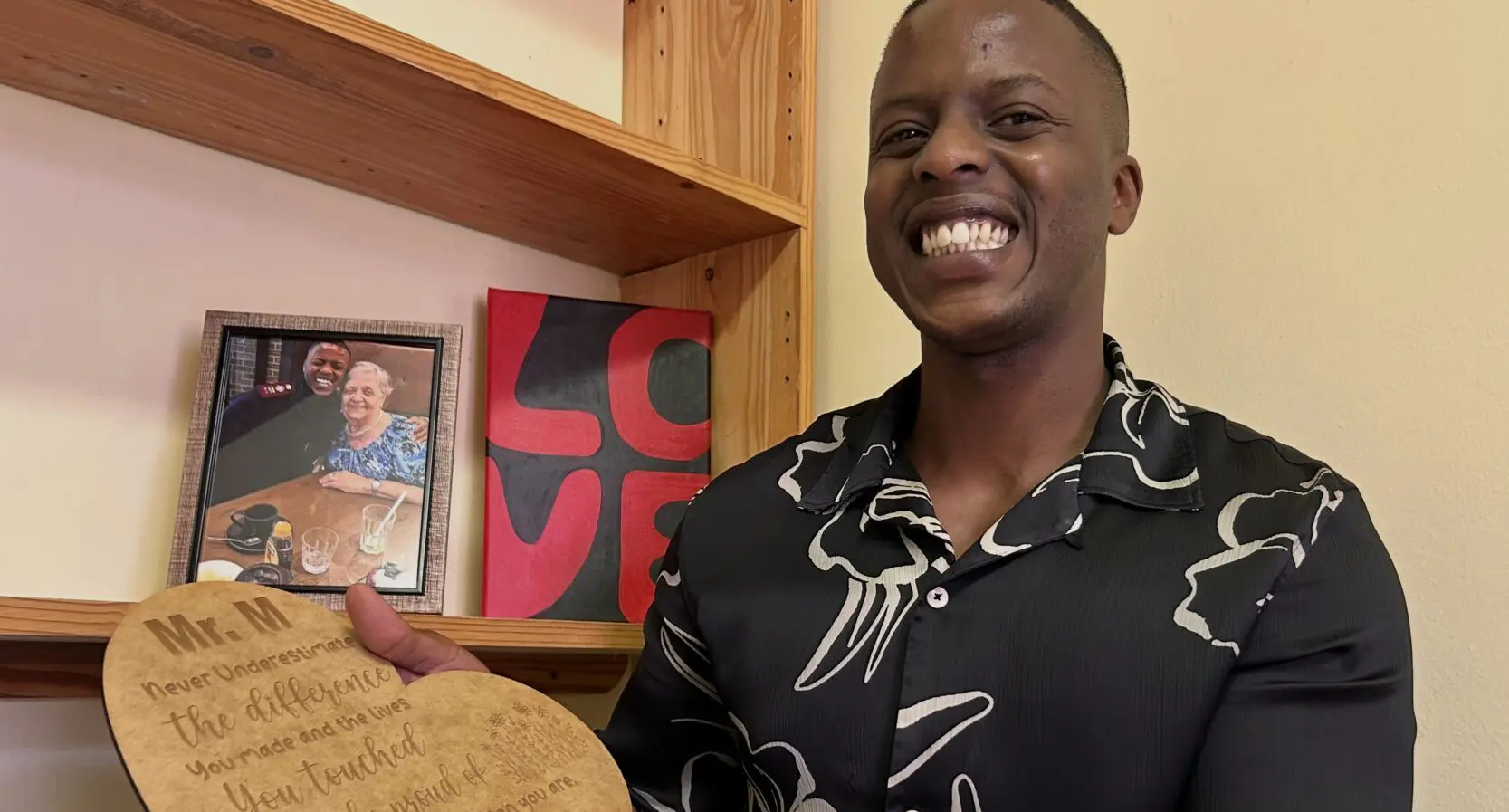
Spotlight is meeting with Munyemana inside his office at the Brooklyn Chest Hospital, which specialises in drug-sensitive and multi-drug-resistant TB. His office walls are yellow, the same colour as the exterior of the hospital buildings, scattered about the vast property in Ysterplaat, Cape Town. On an office shelf, there is a framed photograph of him with a patient from Goodwood, taken during a breakfast at Mugg & Bean, and a wooden heart inscribed with a message to him: “Mr M, never underestimate the difference you made and the lives you touched…”
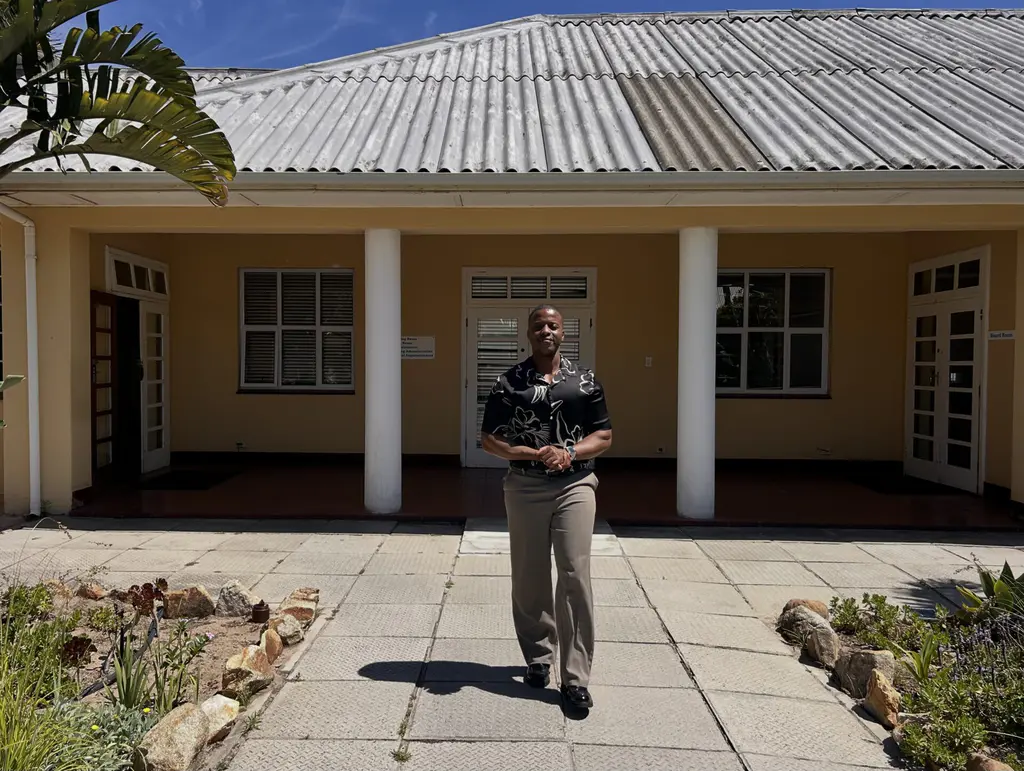
Munyemana relays that in July he started as quality assurance manager for TB across the Cape Town Metro health district, thus at the metro’s two dedicated TB hospitals – Brooklyn Chest Hospital and DP Marais TB Hospital in Retreat.
“I got a promotion. And my experience so far at Brooklyn Chest, I’m loving it so much. Everything has just been smooth sailing,” he says. Essentially, the position deals with “patient-centered incidents” and complaints by patients, he says, plus hospital audits and compiling standard operating procedures.
TB long stays and behavioural challenges
What are patient-centered incidents? He explains: “So the demographic of patients we have is very diverse. We have patients from impoverished areas, we have patients from high-end areas; some of them are also substance users. They can’t use substances in the hospital, and obviously some of them are going through withdrawal which can then lead to anger, to fighting and absconding, all these things happen. So at Brooklyn and at DP Marais, we have behavioural challenges.”
Top of the list, he adds, is patients absconding. “They leave the hospital because they need to get a quick fix, they need to go out into their families. Remember, TB hospital is a long stay. Six months, three months, up to a year. So those patients, they opt to leave and jump out, over the fence, past security and run away. That’s one of the patient-centered incidents I receive. Falls is another one. And then fights, obviously.”
In June and July, there were 16 such incidents at Brooklyn Chest, and 13 at DP Marais. In August and September, 14 at Brooklyn Chest and one at DP Marais.
How many complaints does he receive? Munyemana laughs, pointing at bright sticky notes on the monitor of his desktop computer. “Complaints, complaints everywhere,” he says, chuckling. But then he adds, more seriously: “No actually, the complaints have come down significantly.”
In June and July, he says, there were six complaints at Brooklyn Chest and two at DP Marais. In August and September, there were only one complaint at Brooklyn Chest, and one at DP Marais. Most complaints relate to fellow patients, nursing staff or kitchen staff and meals.
“So if the patient complains, my role is to acknowledge the complaint within five days,” he says. “I go to the patient, I do an investigation. If it is against the kitchen staff or the nursing staff, I go directly to the supervisor, make them aware of the complaint, and we sort of draw a plan of how we’re going to address the complaint. If it’s about, for example, the food is not enough, we’ll then do a kitchen audit, to see the portion. And then give feedback to the patient. There is 25 days to complete the complaint.”
Rwanda roots and Mama Africa
Munyemana says his family hails from Rwanda but moved to Kenya to escape the conflict, where he was born. Then, the family moved to Cape Town where he attended Little Rascals preschool in Parow. He relays how, at this time, he chose to be a doctor in a preschool play.
At Bellville Technical High School, he selected subjects geared towards a future in healthcare. Perhaps this was partially due to the influence of his mother, known as “Mama Africa” for her community spirit and for providing home-based care back in Rwanda, even though she did not have formal medical training. “My mother just has so much to give. And I realised that that’s something I inherited from her. I learned my core motto from her: for the community, by the community, with the community,” says Munyemana.
Growing up, his mother was a librarian at the University of Cape Town, and his father a small business manager. A memory from youth is his mother reading to him from Charlotte’s Web, the American children’s book about a friendship between a pig and a barn spider.
TikTok nurse
Munyemana says initially he viewed nursing as a career for women. But at his mother’s encouragement, he agreed to try it. He completed a four-year Bachelor of Nursing degree at the University of the Western Cape, enrolling for community service at the Elsies River Community Health Centre.
“I loved it from the first moment,” he says.
“I started in the trauma unit, which was very hectic. You can imagine a 19, 20-year-old working in the trauma unit of an impoverished area with crime, drugs, a lot going on. I used to stitch patients, I used to deliver babies,” he says.
He recalls how he treated between 70 and 100 patients a day in the trauma unit, with numbers spiking on SASSA (South African Social Security Agency) pay-days, and over weekends. During the pandemic, he started making his first viral TikTok videos, showing behind the scenes healthcare moments with touches of humour. And so his online persona of “TikTok nurse” was born.
Munyemana explains that there are rules for his content: no patients are to be shown in wards, no facility naming to be displayed, plus light banter only, no dark humour. Despite his online fandom, he insists that he is introverted and shy. “I promise you, people don’t know about me! But I’m introverted. I’m very shy,” he says. “I just love laughing though. I love being around people. But I love my quiet time alone too.”
Have hobbies after-hours
How should nurses protect their mental health? “Have a life outside your job,” he says. “Find a hobby; whether it’s running, wellness, cooking, fashion, makeup, hair, knitting. For me, its social media, and health and wellness and fitness.”
More from Spotlight
Indeed, Munyemana’s social media accounts show him living an influencer’s life, frequenting fine Cape Town restaurants and trendy gyms over weekends. “My best was my birthday this year,” he says. “At the One & Only hotel. It was an experience I will never forget. It felt so lush. I started off at the spa and then the pool situation. And then, over to the hotel for one night with dinner at Nobu. Best ever. The sushi – I’m not really a salmon roses kind of person, but those were great.”
He reiterates that nursing professionals need to focus on “themselves”, on what makes them happy. On having fun after-hours.
“For me, if I look good, I feel good. I do good. That’s my thing. My mom will tell you I’ve always been like this. Since an early age, I’ve always been cutting my own nails. Cutting my hair. Ironing my own shirts before school. I got into skincare at a very young age. I’ve always loved looking after myself, while also wanting to care for other people,” he says.