
Some South African pharmacists can finally offer HIV prevention services without a doctor’s prescription. But regulatory approval alone will not make these services accessible, affordable, or widely used by the people that need them most, argue Angela Tembo and Dr Deanne Johnston.
Pharmacist-initiated management of antiretroviral therapy, or PIMART, allows specially trained and accredited pharmacists to test people for HIV and to start them on HIV prevention and treatment medicines.
For years, the hurdle was regulation. Originally gazetted in 2021, it was delayed for more than three years by a court challenge from a private doctors’ group, which argued that it encroached on the work of medical doctors. That challenge ended only when the Supreme Court of Appeal dismissed the case in October 2025.
In August 2026, the South African Pharmacy Council (SAPC) announced that applications for temporary permits were open, allowing pharmacists who trained in 2021 to provide HIV testing, pre-exposure prophylaxis (PrEP), and post-exposure prophylaxis (PEP) without a prescription from a doctor. The first pharmacists have now started receiving these permits issued by the Director-General of Health and are ready to provide services.
Meanwhile, the SAPC is reviewing PIMART courses submitted by training providers for accreditation. Pharmacists completing these courses will be able to practice under the full PIMART scope, which, unlike the current permits, would include the green light for prescribing and dispensing HIV treatment to people living with HIV.
PIMART PARTLY TAKES OFF | Specially trained pharmacists can now begin applying for permits to dispense antiretroviral medicines for HIV prevention without a doctor’s prescription. www.spotlightnsp.co.za/2026/08/26/s…
— Spotlight (@spotlightnsp.bsky.social) August 26, 2026 at 11:03 AM
[image or embed]
With the regulatory barriers largely resolved, the question is no longer whether pharmacists can provide HIV services, but whether they can do so at a scale that contributes to South Africa’s HIV response in a programme severely disrupted by the sudden withdrawal of donor funding in early 2025.
Besides counselling, HIV services depend on three key ingredients – testing, laboratory services and medicines. At each step, the critical question is what it will cost the client in terms of time, effort, and money? The answer is likely to determine whether PIMART’s substantial positive potential for our HIV response will be fulfilled.
Why pharmacies matter
South Africa has more than 4 000 registered community pharmacies, and the two largest chains alone operate more than 1 100 of them. One of those chains reports 13.1 million active loyalty-card members accounting for 84.2% of sales, a measure of how many people already visit pharmacies regularly and could potentially be reached with HIV testing and linked to prevention or treatment. With long opening hours and locations close to where people live and work, community pharmacies are among the most accessible places to offer these services.
We have seen what this can look like with a pilot programme that Ezintsha ran from 2022 to 2026 across 10 community pharmacies in Gauteng and the Western Cape. It showed high uptake with 89% of interested and eligible clients starting HIV prevention pills. Of the 1 697 people who started taking the pills, 11.1% had previously used them before, so pharmacies were reaching new people rather than moving existing clients out of clinics. Furthermore, clients told us they valued a setting that does not feel like a clinic. The pilot also showed that HIV prevention can be integrated with broader sexual and reproductive health services and delivered through infrastructure that already exists.
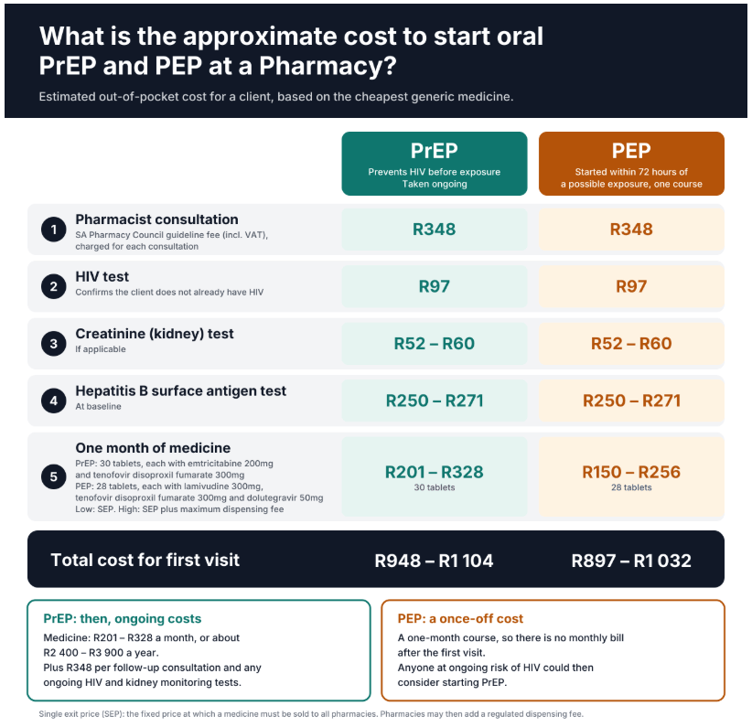
Community pharmacies already serve clients who value convenience, discretion and shorter waiting times, and who are willing and able to pay for these benefits. Thus, there will likely be a market for pharmacy-based HIV services at current prices. As seen in the below infograph, both PrEP and PEP are likely to cost around R1000.00. For PrEP, there will be ongoing monthly costs, while PEP is a once-off.
However, the challenge is scale. More than 80% of people in South Africa rely on the public health sector where the demand for HIV services is the greatest. If PIMART is to contribute meaningfully to South Africa’s HIV prevention goals, pharmacy-based HIV services must be affordable to existing pharmacy clients and also the much larger population that depends on the public healthcare system. Three practical barriers stand in the way.
It all starts with testing
Pharmacies offer convenience since a person can walk in without an appointment, after work or over a weekend. Testing at a pharmacy clinic costs approximately R97. It is not known if the cost of this test will be included in the PIMART consultation fee.
A person who tests negative can start taking prevention medicines right away. If they had a possible HIV exposure in the past 72 hours, they should be offered PEP immediately. A person who tests positive can be linked to treatment, which can be started on the same day.
This same-day convenience at the pharmacy only matters if the people who need it can afford it. Access to government-supplied HIV test kits could substantially reduce the cost of pharmacy-based HIV prevention and make these services accessible to many more people.
The link to laboratories
Access to laboratories could be a challenge. Starting PEP or HIV prevention treatment safely involves more than an HIV test. Depending on the client, national guidelines call for baseline tests such as kidney function and hepatitis B screening, with ongoing monitoring for some. Pharmacists providing PIMART can currently use only private laboratory services, so these costs are passed on to the client.
At present, there is no standard way to do this. Many pharmacies have partnered with private laboratories, while others refer to doctors for specimen collection and laboratory referrals. Private laboratories charge for each test, adding to the client’s cost. Baseline creatinine costs around R55, whilst hepatitis B surface antigen tests cost between R250 and R271. Clients accessing PIMART services in the private sector cannot currently access laboratory services through the National Health Laboratory Service (NHLS). It is not yet clear whether, or on what terms, pharmacists will be able to do so in the future.
More from Spotlight
The question of linking to laboratories will become even more urgent when PIMART expands to include HIV treatment, which is expected once an updated training course is accredited. Starting and monitoring HIV treatment depends on tests such as CD4 counts and viral loads, both of which are expensive in the private sector. HIV treatment is not within the scope of the temporary permit, but this is why now is the time to plan. If we wait until pharmacists are permitted to start treatment before asking how laboratory results and reporting will work, we will repeat the delays of the past five years.
Affordable medicines
Private-sector medicine prices in South Africa are regulated. Every medicine has a fixed price at which it must be sold to all pharmacies, and a pharmacy may then add a dispensing fee up to a regulated maximum. The cheapest HIV prevention pill available through pharmacies costs just over R200 for a monthly supply, rising to about R328 if the pharmacy charges the maximum dispensing fee. Over a year, a person paying out of pocket would spend between roughly R2 400 and R3 900 on the medicine alone. However, not all pharmacies may stock the cheapest available generic medicine and variations in the cost of medicines is highly likely.
A course of the cheapest generic PEP costs slightly less than a month of prevention pills, about R150 or about R256 with the maximum dispensing fee. This is typically a once-off cost.
Added to this is the pharmacist’s time. The South African Pharmacy Council has set PIMART consultations at R348. It is a guideline rather than a mandatory tariff, so pharmacies may charge less if they wish.
Moving beyond permits
Public-private partnerships has huge potential for making all these services more widely available. For instance, we already have family planning services available in some community pharmacies where government-funded contraceptives are dispensed to people free of charge while the client pays only a minimal fee for the service. A similar arrangement for HIV could give PIMART pharmacies access to government-supplied HIV tests, PrEP, PEP and, in time, antiretroviral therapy. Pharmacies would still need to be reimbursed for delivering the service, and sustainable mechanisms for this need to be explored, whether through medical schemes or government funding.
What is needed now for PIMART to have impact is a practical implementation agenda. This agenda should guide stakeholder collaboration on key areas such as tests and medication, access to the NHLS’s laboratory services, payment for pharmacists’ professional services, and reporting into government’s health information systems.
In short, if pharmacies gain access to state-supported tests, laboratory services and medicines, they could become one of the country’s most effective platforms for expanding HIV prevention. Otherwise, PIMART risks improving convenience for those who already have options while doing little to expand access among those most at risk of HIV.
*Tembo is Director of Pharmacy Health at Ezintsha, Faculty of Health Sciences at the University of the Witwatersrand. Johnston is a Senior Lecturer in Pharmacy Practice at the University of KwaZulu-Natal.
Note: Spotlight aims to deepen public understanding of important health issues by publishing a variety of views on its opinion pages. The views expressed in this article are not necessarily shared by the Spotlight editors.