
The woman caring for Cape Town’s homeless once numbed her own pain with opioids
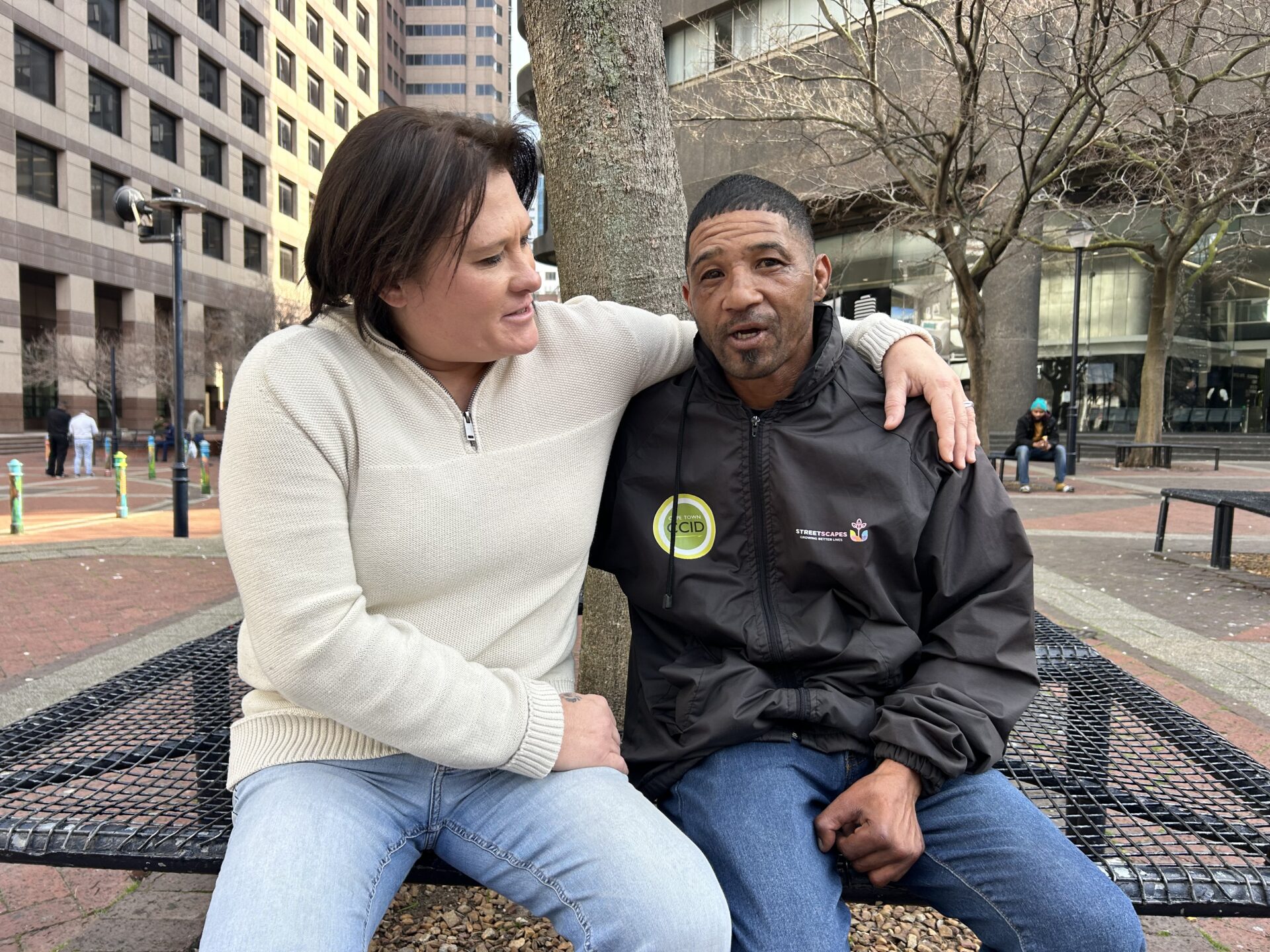 Tara Gerardy-Bissolati and Eugene Meyer outside the CCID offices in central Cape Town. (Photo: Biénne Huisman/Spotlight)
With glimmers of tenderness beneath a stoic façade, Tara Gerardy-Bissolati tells Spotlight about her struggle to beat opioids, why homelessness is a public health issue, and her commitment to bring hope to people living rough in central Cape Town.
As winter sweeps over Cape Town, it is Tara Gerardy-Bissolati’s job to help care for up to 5 000 homeless people sleeping rough in the city’s centre. The total number of homeless people in the entire city has previously been estimated to be as high as 14 000.
Gerardy-Bissolati is the social development manager at the Central City Improvement District (CCID) and refers to people settled on the city’s streets as “clients”. It is her business to know their names and stories, to instil in them dignity and hope for change.
“People do move around but my team know the clients within the precinct, they know them by name. They can ascertain who’s new; obviously you’d want to engage with that person and load them onto our database as a new client,” she says.
Through a pioneering peer-led project, Gerardy-Bissolati’s team aims to break the cycles of poverty, substance abuse, and despair that push people onto society’s periphery, keeping them stuck. In this project, former street-dwellers and substance abusers are trained to support and incite hope in homeless people, instilling in them the belief that their stories can change, too.
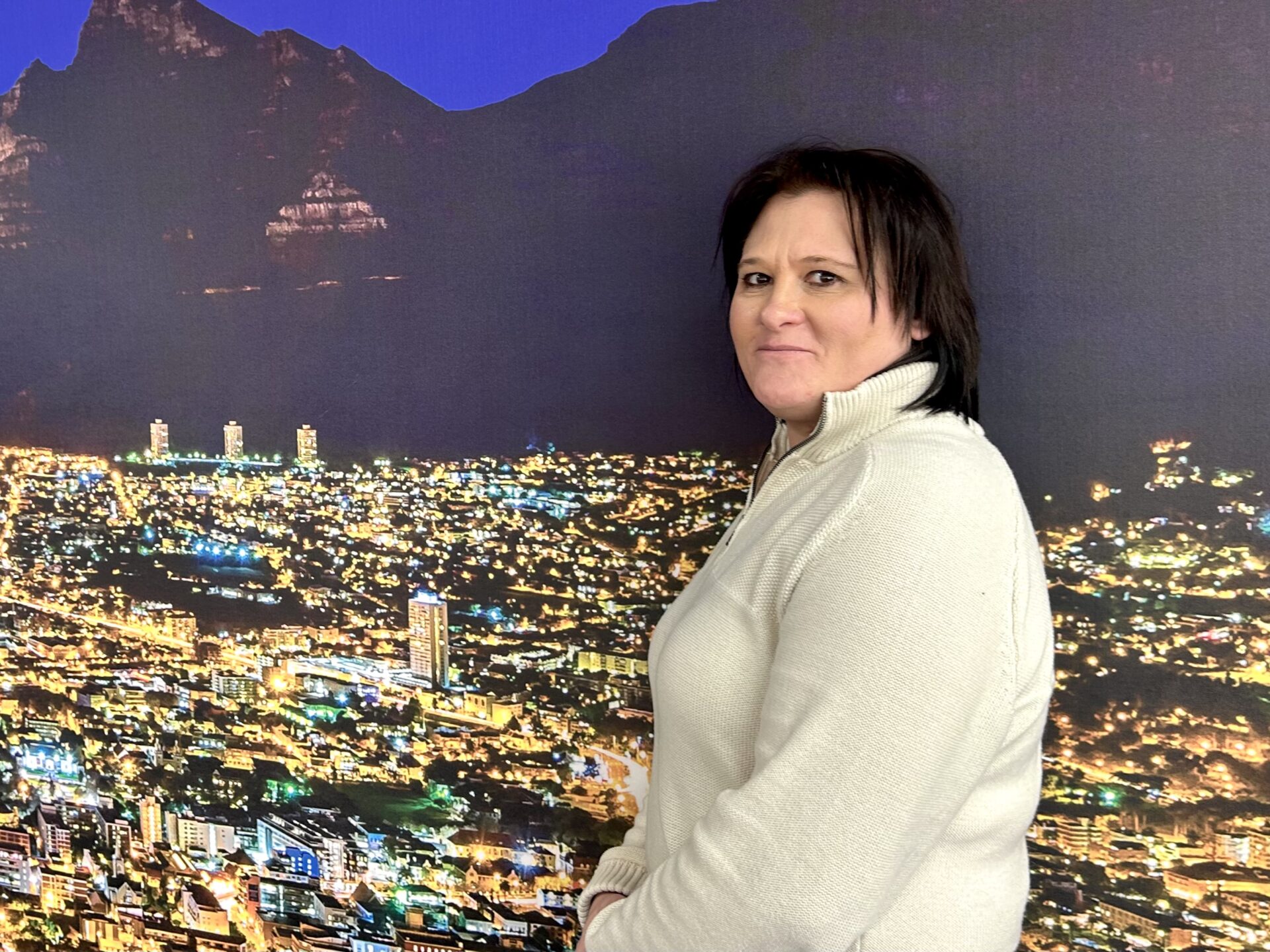
Speaking inside the CCID’s 13th floor office boardroom, she says: “When you’re facing harsh weather conditions, it’s a sad situation and a very difficult cycle to break.”
“I think for the chronic homeless, they’re used to living life on their own terms. To take them and put them back into society with a whole bunch of rules; or even into a shelter, with a whole bunch of rules that they’re not used to. That can be difficult and problematic,” she says.
Peer field workers
To that end, engaging through peers who are relatable is key. “The peer field workers are former homeless people who are on the up; who are now educating others, building trust, inspiring them, showing them that it’s possible,” she says. “The peers have been there and got through it, and with that comes empathy that is hard for anyone else to emulate.”
Gerardy-Bissolati says she manages 20 peer field workers across the CCID’s 1.74 square kilometre footprint, which includes the Foreshore, retail hub Adderley Street, the legal and government districts, and restaurant-lined Bree Street. The peer field workers are housed with partner non-profit organisations like The Haven Shelter.
Emergency safe sleeping zone
Nightly, over four months this winter, six peer field workers preside over a fenced-in emergency winter sleeping facility erected underneath the Selkirk Street carriageway in District Six.
Gerardy-Bissolati slept over at the “safe sleeping zone” when it was launched in June. On that night, she huddled under blankets on a fold-up stretcher, alongside 27 clients on similar makeshift beds. Asked about the experience, she shrugs and smiles: “It was fine, I slept. I was warm enough.”
The carriage way shelter opens nightly at 19:00 with a capacity for 60 people. Final entry is at 21:30, with an exit time of 06:30 the next day. Gerardy-Bissolati emphasises that it is an emergency space for helping people through the harshest cold, and that it’s not intended for long term accommodation.
After our interview, she puts an arm around peer field worker Eugene Meyer as they pose for a photograph. Meyer, originally from Delft, joined the CCID team nine months ago, before which he lived on the streets. “He’s doing so well,” she says, glowing.
A public health issue
Gerardy-Bissolati insists that homelessness is a public health issue that extends beyond law enforcement. Homeless people living on pavements and public spaces can be evicted by City of Cape Town officials once a lawsuit is filed and permission is obtained from a court. “The challenge with removing clients is that they set up somewhere else,” she says. “And the cycle continues. So what we try to focus on are those clients who are really committed to change.”
On the intersection of homelessness, substance abuse and mental health, she says: “Your chronic homeless people who have been on the streets for most of their life; as a means of coping, they turn to substances. Some of these substances can cause mental health conditions like psychosis. And then of course you could have pre-existing mental health [conditions] as well. People with schizophrenia, they are more prone to end up on the street.” Studies corroborate that people with schizophrenia are more vulnerable to homelessness.
Related Posts
On youth living on the streets, Gerardy-Bissolati says: “I think children at a very early age get involved in substances because very often they’re exploited. So they start with marijuana, glue sniffing, that sort of thing, and then progress on to harder drugs.”
She says the two most common drugs on Cape Town’s streets are heroin and methamphetamine, known as tik. “Obviously you get marijuana and cocaine and things like that, but your prominent ones are heroin and tik. Methamphetamine is typically what results in psychosis,” she says. Spotlight previously reported on research suggesting that a few hundred thousand people in South Africa use heroin every day.
Before joining the CCID four years ago, Gerardy-Bissolati headed harm reduction strategies at non-profit organisation TB HIV Care, as project manager of their People Who Inject Drugs programme. At the CCID, her role includes harm reduction education, too. “Encouraging clients to use [heroin] safely, to have proper injecting techniques, that sort of thing, using outside of the public eye,” she says.
Fentanyl entering local drug supply
Gerardy-Bissolati relays that, alarmingly, the synthetic opioid fentanyl has entered local drug supply. “And what’s starting to happen in South Africa now is that fentanyl is being cut with heroin, which is incredibly dangerous,” she says. “It can very often result in overdose and sometimes even death. So it’s very important to implement overdose prevention amongst those communities so they have the knowledge and know how to act when their friend has an overdose.”
A potent synthetic opioid and pain killer, fentanyl was approved for medical use including as aneasthesia and cancer treatment in the United States in 1968. The lab-made painkiller is also used in hospitals in South Africa. However, illicit fentanyl has flooded illegal drug markets in the United States, giving rise to a public health crisis and an epidemic of overdose deaths. According to USAFacts, which publishes government data, over 72 000 people died from fentanyl overdoses in the United States in 2023.
DO YOU KNOW THEM? | Every August we highlight women across healthcare, science, and medicine who are leading with distinction locally and internationally.
See our list for 2025: shorturl.at/i3ICCJoin our mailing list: shorturl.at/Ntzoa
— Spotlight (@spotlightnsp.bsky.social) December 19, 2025 at 1:33 PM
In South Africa, there is a paucity of reliable data on overdose deaths amongst homeless people, says Gerardy-Bissolati. “South Africa doesn’t have much data on these deaths. A lot of it doesn’t get to the clinics, it doesn’t get to the hospitals. They die in their communities. Also because there are so many co-morbidities, people are not recording it as an overdose specifically. And that’s the challenge.”
The biggest cause of death on the city streets is co-morbidities, she says, reiterating a lack in reliable data. “Living on the streets, TB, possibly HIV, those are your biggest or associated illnesses. Again, it’s difficult to put a number on that.”
Her own journey with addiction
Gerardy-Bissolati knows first-hand what it is to battle opioid addiction. In her first year of high school in Gqeberha, she says she had knee surgery and was given an“open prescription” for the painkiller Synap Forte which contains codeine, an opioid. Legally, prescriptions have to be reissued every six months, or more frequently in some cases. However, prior to the tightening up of regulations in the early 2000s people found some work-arounds that enabled open-ended prescriptions.
As an adolescent, she says she developed tolerance and dependence. “I would take the regular dose, but then eventually the tolerance builds and it’s not enough to get rid of the pain. And that’s how things escalate.” She had abused the drug for at least two years, when she was successfully treated for addiction in Grade 10, at which time she says she also founded a drug support group for fellow teenagers struggling with addiction.
After matriculating, Gerardy-Bissolati says she worked in the ambulance service in Kilkenny, in Ireland, for ten years. Here she relapsed after surgery to her back, when, despite her history, she was prescribed a strong opioid pain medicine.
“I was given OxyContin [oxycodone] which is probably stronger than heroin. The relapse was immediate, it was bad. Long story short, I said to all my doctors ‘I need your help,’ ‘I need to change my life.’ And that’s when I went on to methadone [a synthetic opioid medication used to treat opioid abuse]. Later, I got myself off of methadone, which is a foreign concept overseas because everyone likes to stay on it…” she says.
South Africa’s Drug Master Plan recommends that methadone should be offered to people who have been hospitalised for opioid withdrawal. In these cases, the treatment is given to patients for up to 10 days.
Emotional pain
Gerardy-Bissolati came to understand that her opioid abuse was not only linked to physical but also emotional pain. “I maintained that addiction very much stems from one’s trauma. And if you can resolve that trauma, the addiction will resolve itself,” she says.
She reflects: “I had a great upbringing. My parents were good to me. But what I was looking for was an emotional connection from my dad, which only years later I understood he wasn’t capable of providing because of the way he grew up. But something as simple as that can be trauma and can be a reason to continue to stay numb, not to feel. Because essentially that’s what opioids do, they suppress your emotion.”
Gerardy-Bissolati says she completed a Postgraduate Diploma in Addictions Care at the University of Cape Town despite being the only one in her cohort not having an undergraduate qualification. “I was accepted purely based on my personal and professional experience,” she says.
Her own past gives her insight into the plight of homeless people. “I think that’s what makes me relatable to clients,” she says. “I understand their journey. You know, I’ve never been homeless, fortunately. But one can imagine yourself in those shoes. And certainly, if I was homeless, I don’t think I would be off substances quite honestly, because it’s a means of coping.”
Gerardy-Bissolati’s demeanour is pragmatic, but with glimmers of tenderness beneath the stoic facade. She recalls how in March she lost a pregnancy but continued working. “I think I’m only starting to grieve that now,” she says, quietly. “But at the time, I needed to be professional, a mirror to the clients.”
Despite the demands of her job, reflecting on her career, Gerardy-Bissolati says she would not change a thing. “My passion was always working with people. I think always, people just gravitated towards me, people who needed help.”
The CCID is a non-profit organisation funded by ratepayers in central Cape Town. They collaborate with the City of Cape Town in a public-private partnership.
*This article is part of Spotlight’s 2026 Women in Health series, featuring the remarkable contributions of women to healthcare and science.
