
The number of people falling ill with TB in South Africa is declining year-on-year, but the number of deaths due to the disease remains stubbornly high. Spotlight reports on the latest statistics.
An estimated 235 000 people in South Africa fell ill with tuberculosis (TB) in 2025, while around 53 000 died of the disease. This is according to the World Health Organization’s (WHO) latest TB estimates, published this week alongside its Global Tuberculosis Report 2026. You can see the WHO’s TB country profile for South Africa here.
There is a clear downward trend in the number of people falling ill with TB. According to the WHO, South Africa’s TB incidence rate has declined by 63% since 2015. By contrast, the absolute number of annual deaths due to TB have declined by only 19% over the same period.
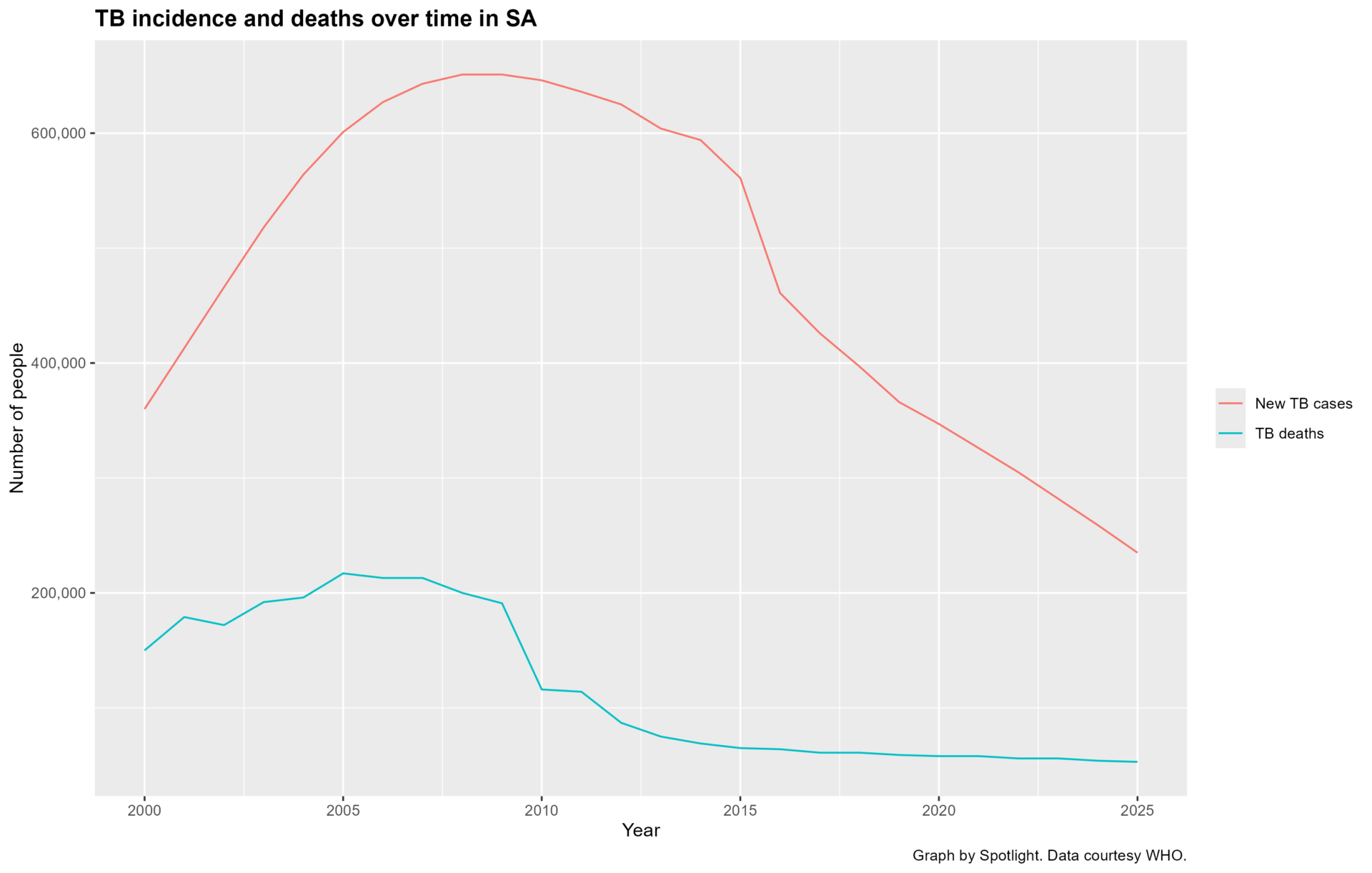
South Africa’s TB epidemic continues to be closely intertwined with HIV. Of the 235 000 people who fell ill with TB in 2025, an estimated 139 000 were living with HIV, and of the 53 000 TB deaths, just over half (27 000) were in people with HIV.
There were an estimated 14 000 cases of drug-resistant TB in the country in 2025.
The numbers in context
The new WHO TB incidence estimates are substantially lower than estimates from Thembisa, the leading mathematical model of HIV and TB in South Africa. According to Thembisa, an estimated 306 000 people aged 15 and older fell ill with TB in South Africa in 2025. The mortality figures are much closer though, with Thembisa also estimating 53 000 TB deaths in 2025 (although its estimate is only for people aged 15 and older).
The WHO and Thembisa estimates of the number of people who died of TB in 2025 are both more than double the numbers reported by Statistics South Africa (just under 19 000 in 2024). This difference is not unexpected since the WHO and Thembisa produced model estimates, while Stats SA’s mortality figures are essentially just a count of what is indicated on death notifications. There is good evidence showing that certain conditions are systematically under-reported on death notifications in South Africa.
A further nuance is that the WHO’s headline figure of 235 000 people falling ill with TB refers only to people who fell ill with TB in 2025. Many people who first fell ill with TB in 2024 would still have been ill with TB in 2025, and thus the total number of people who were ill with TB in 2025 is substantially higher than 235 000.
‘Missing cases’
Much has been made in recent years, including by Spotlight, about the many people who fall ill with TB who are not diagnosed or diagnosed late, a group sometimes referred to as the ‘missing cases’.
The number of people diagnosed with TB every year in South Africa has generally hovered at around 200 000. But while that number has been relatively stable, the WHO’s estimates of the actual number of TB cases have declined from over 300 000 to the current 235 000. If these estimates are accurate, then the number of ‘missing cases’ is only around 35 000, a far distance from the estimates of over 100 000 just five or so years ago.
Related Posts
It would be premature however to conclude that non-diagnosis or late diagnosis is no longer a problem in our TB response. First, the WHO itself is clear that its 235 000 estimate is very uncertain – their 95% uncertainty interval places the real number in the range from 148 000 to 342 000. It is also worth keeping in mind Thembisa’s much higher estimate of 306 000 people 15 and older falling ill with TB in 2025. And second, there is much good evidence showing that people with TB symptoms in South Africa are often not diagnosed, or diagnosed late.
According to a recent modelling study, a major gap in South Africa’s TB response is that many people who present at South Africa’s public sector clinics with TB symptoms are not offered TB tests. The classic symptoms of TB include persistent cough, night sweats, fatigue, chest pain, fever, and unexplained weight loss. The modelling suggests that simply testing more of the people presenting with these symptoms is one of the most effective things we can do in the fight against TB.
The bigger picture
Globally, an estimated 10.6 million people fell ill with TB in 2025 and 1.1 million people died from TB. Of the 10.6 million, only 8.4 million were diagnosed, leaving an estimated 2.2 million either undiagnosed or unreported, according to the WHO.
“The continued decline in TB cases and deaths is very encouraging, especially given the challenges many countries have faced from funding cuts,” said Dr Tedros Adhanom Ghebreyesus, WHO Director-General, in a media statement. “Many governments have dug deeper into their own budgets to protect the gains they have made. And yet, more than one million people still die each year from a disease that is preventable and treatable. We urge countries and partners to urgently expand access to TB services, protect essential funding and accelerate the development of new tools to end this epidemic.”
“With deaths falling by 35% since 2015 and treatment saving an estimated 86 million lives since 2000, the world has reached the first mortality milestone of WHO’s End TB Strategy, although five years later than planned. And progress has come too slowly,” the WHO said in its media release. “Since 2015, the global TB incidence rate (new cases per 100 000 population) has declined by 14%, far short of the 50% reduction milestone for 2025, and TB remains the leading cause of death from a single infectious agent.”