
What the Public Protector’s food safety investigation reveals about Gauteng’s public health early warning system
 Environmental Health Practitioners regularly test drinking and recreational water to detect contamination and help prevent diseases such as cholera and typhoid. (Photo: Unsplash)
From inspecting spaza shops to monitoring water quality, Environmental Health Practitioners help prevent disease before outbreaks occur. A Public Protector investigation reveals why Gauteng municipalities are struggling to deliver these essential public health services. The investigation also helps clarify what will be at stake in South Africa’s local government elections in November.
Environmental Health Practitioners (EHPs) operate as the public health system’s early warning system. They are responsible for identifying and managing environmental health risks before they become public health emergencies.
Whether inspecting food premises, monitoring water quality or investigating environmental health hazards, their work is designed to avert illness. These preventative functions form part of the municipal health services that local governments are required by law to provide and what will be at stake in the local government elections in November.
The importance of these largely invisible health services came into sharp focus when Public Protector Advocate Kholeka Gcaleka released preliminary findings of an investigation into Gauteng’s food safety system on 17 July 2026.

The probe followed a series of food poisoning incidents involving children in 2024. Among the most high-profile was the death of six children who allegedly consumed contaminated food bought from a spaza shop in Naledi, Soweto.
Rather than focusing only on the poisoning incidents themselves, the Public Protector’s office examined whether Gauteng’s municipalities were adequately delivering the municipal health services responsible for regulating food safety and hygiene standards in the informal business sector.
As the local government elections draw closer, we unpack how municipalities use environmental health services to prevent harm and protect public health, and find out what happens when that system comes under strain.
To start with, we need to understand what municipal health services are, the responsibilities assigned to municipalities by law, and how those services are intended to function.
What are municipal health services?
Food safety is just one of many municipal health services.
Professor Jaap de Visser, National Research Chair in Multilevel Government, Law and Development at the Dullah Omar Institute at the University of the Western Cape, points to the National Health Act for the full list.
The Act defines municipal health services by naming nine preventative functions, including food control, water quality monitoring, waste management, vector control, and environmental pollution control.
These services are primarily delivered by municipal officials called EHPs. How they perform this work is outlined by the National Environmental Health Norms and Standards.
For example, EHPs routinely collect drinking and recreational water samples for laboratory testing to detect contamination and reduce the risk of waterborne diseases such as cholera and typhoid.
This table below illustrates the key functions they perform to prevent disease before people become ill.
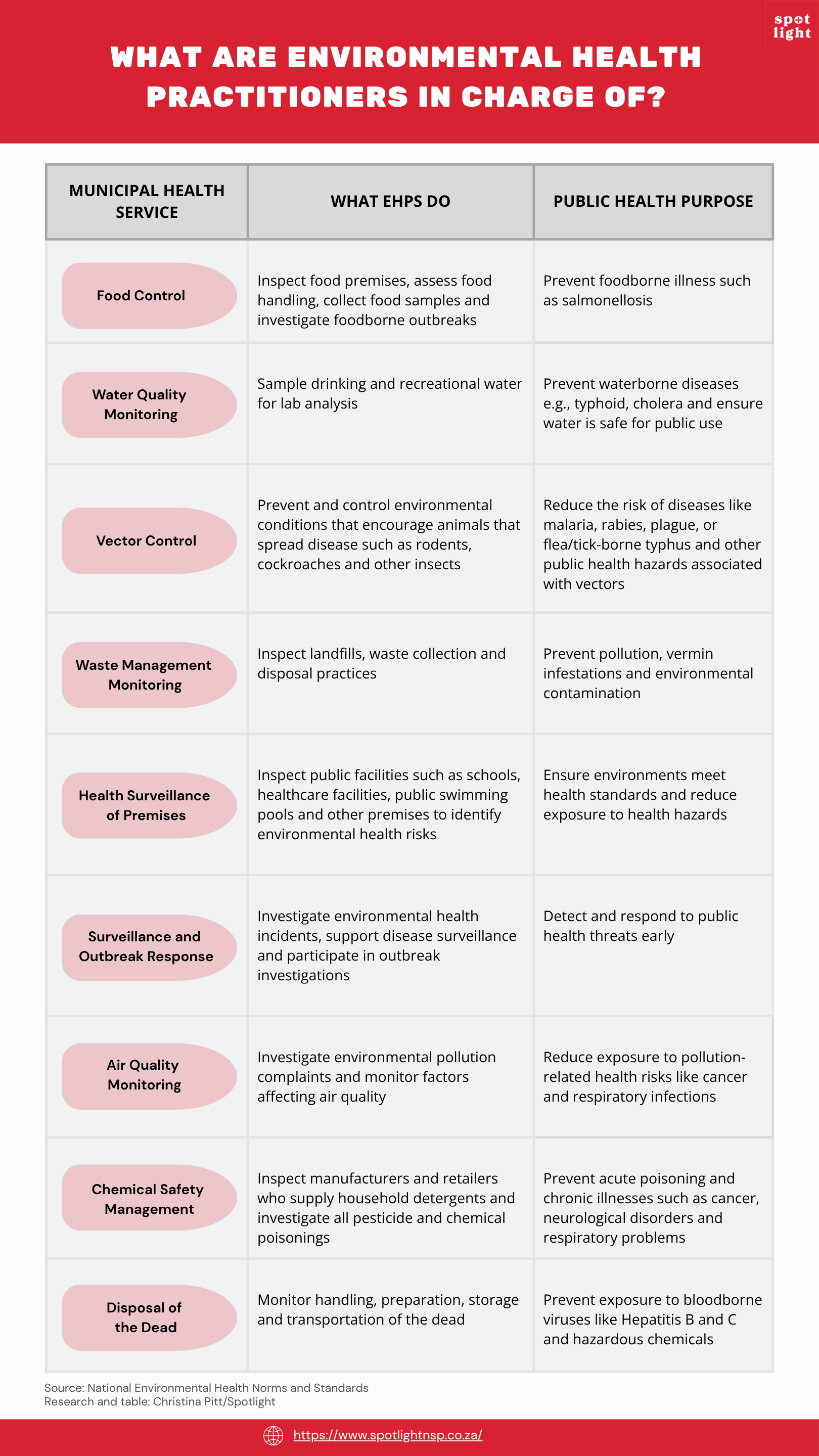
The National Environmental Health Norms and Standards requires EHPs to adopt a preventative, risk-management approach. In practice, this means rather than inspecting every premises equally, they prioritise activities and facilities that pose the greatest risk to public health.
“Higher-risk premises, for example, those handling high-risk foods, with a history of non-compliance, would be inspected more frequently and receive more intensive oversight,” explained National Department of Health spokesperson Foster Mohale. “Conversely, lower-risk premises with a strong record of compliance may be inspected less frequently, allowing EHP resources to be directed where they are most needed.”
EHPs also have enforcement powers when they identify breaches of prescribed health standards. They can issue compliance notices, requiring owners or operators to correct a problem within a specified period.
Their work also includes routine inspections, environmental health surveillance, investigating complaints, and educating communities and businesses.
Who is responsible for municipal health services?
Schedule 4B of the Constitution assigns municipal health services to local government, explains De Visser.
Which municipality is responsible for delivering these services depends on where you live.
In metropolitan municipalities such as Johannesburg, Tshwane and Ekurhuleni, the municipality is responsible for providing municipal health services within its boundaries.
In non-metropolitan areas, the Municipal Structures Act provides that district municipalities are generally responsible, while local municipalities perform the function only where they have been authorised to do so in terms of the Act.
Although municipalities deliver these services, the National Health Act requires them to work as part of a coordinated health system. It establishes District Health Councils to support coordination between national, provincial and local government.
According to Mohale, municipal health services are intended to function as an integrated three-tier system in which national, provincial and district environmental health units work together to deliver municipal health services.
“Working together, these structures are intended to create a coordinated system in which national government sets the policy and regulatory framework, provinces provide oversight and technical support, and district structures coordinate and strengthen implementation at municipal level,” he said.
Food safety provides a useful example of how that system operates in practice.
From farm to fork
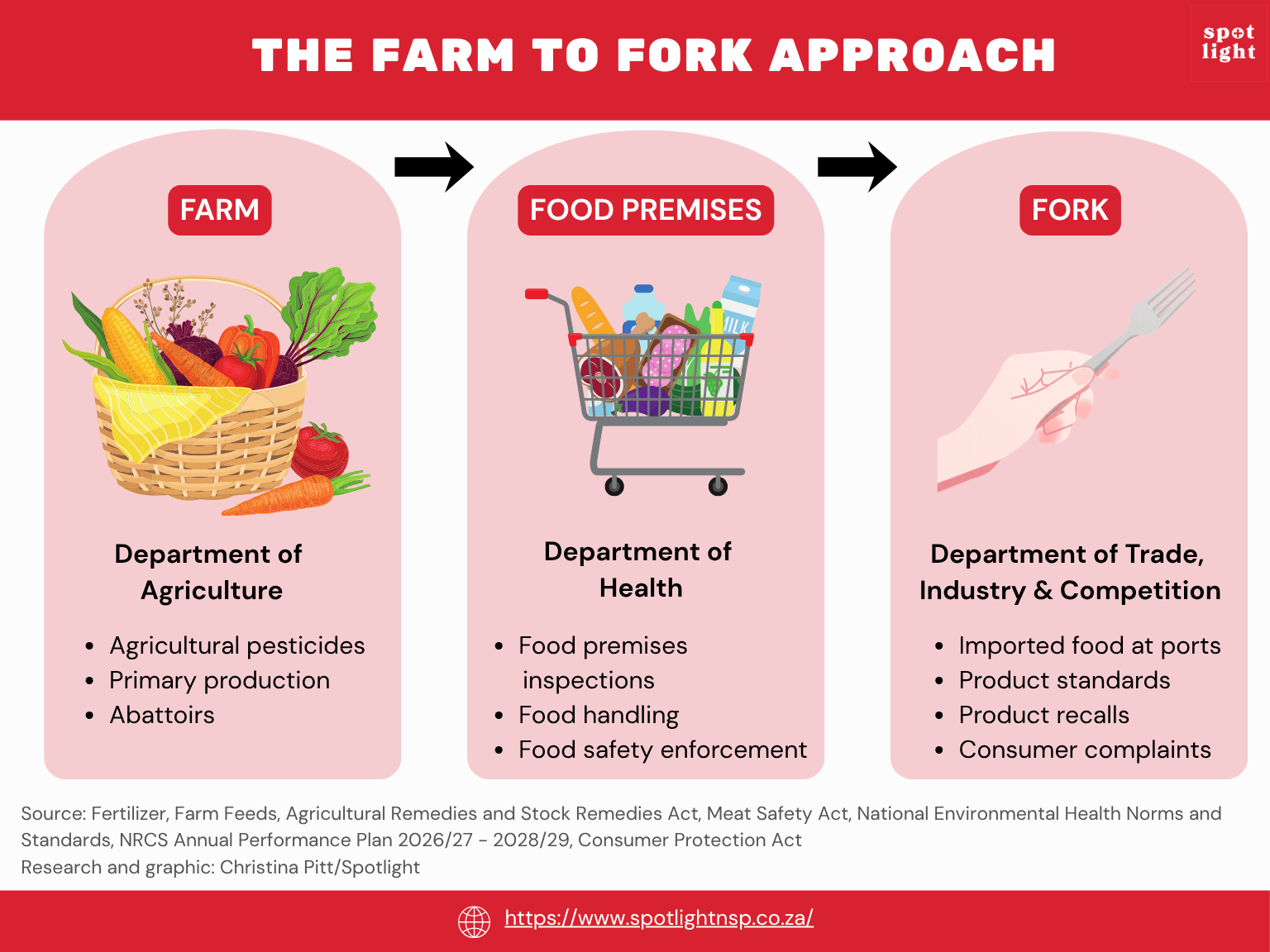
Food microbiologist and food safety expert Professor Lucia Anelich says South Africa follows a “farm to fork” approach, with different institutions responsible for different stages of the food chain.
The Department of Agriculture oversees food safety at the production stage by regulating agricultural pesticides and veterinary medicines as well as food safety in abattoirs.
Once food enters the retail environment, the Department of Health, through municipal EHPs, is responsible for inspecting food premises, checking how food is prepared and enforcing food safety requirements.
The Department of Trade, Industry and Competition provides an additional layer of oversight by inspecting certain imported food products at ports of entry, overseeing product recalls and investigating consumer complaints.
When food contamination is suspected, those responsibilities overlap as the relevant authorities work together to trace the source, remove contaminated products, and prevent further illness. The agencies involved depend on where the suspected source lies within the food chain.
The Public Protector’s Gauteng food safety investigation examined whether the preventative systems intended to identify and manage these risks before outbreaks occurred were functioning as intended.
A break in the chain
The level of coordination required for food safety is not the type of thing that happens by chance.
That is why District Health Councils are tasked with strengthening planning, oversight and coordination between national, provincial and local government.
According to Mohale, these structures are intended to provide a forum for regular engagement between stakeholders, monitor the implementation of environmental health programmes and “ensure that food safety risks are identified and managed proactively.”
Yet, the Public Protector identified a significant weakness in Gauteng’s food safety system with the absence of functioning District Health Councils.
Without them, coordination between different spheres of government becomes more difficult, weakening oversight, planning, and the implementation of municipal health services.
Delivering these services also depends on whether municipalities have enough EHPs to carry out routine inspections.
EHP employment gaps
One of the Public Protector’s clearest findings was that Gauteng municipalities lack sufficient EHPs to carry out their statutory functions.
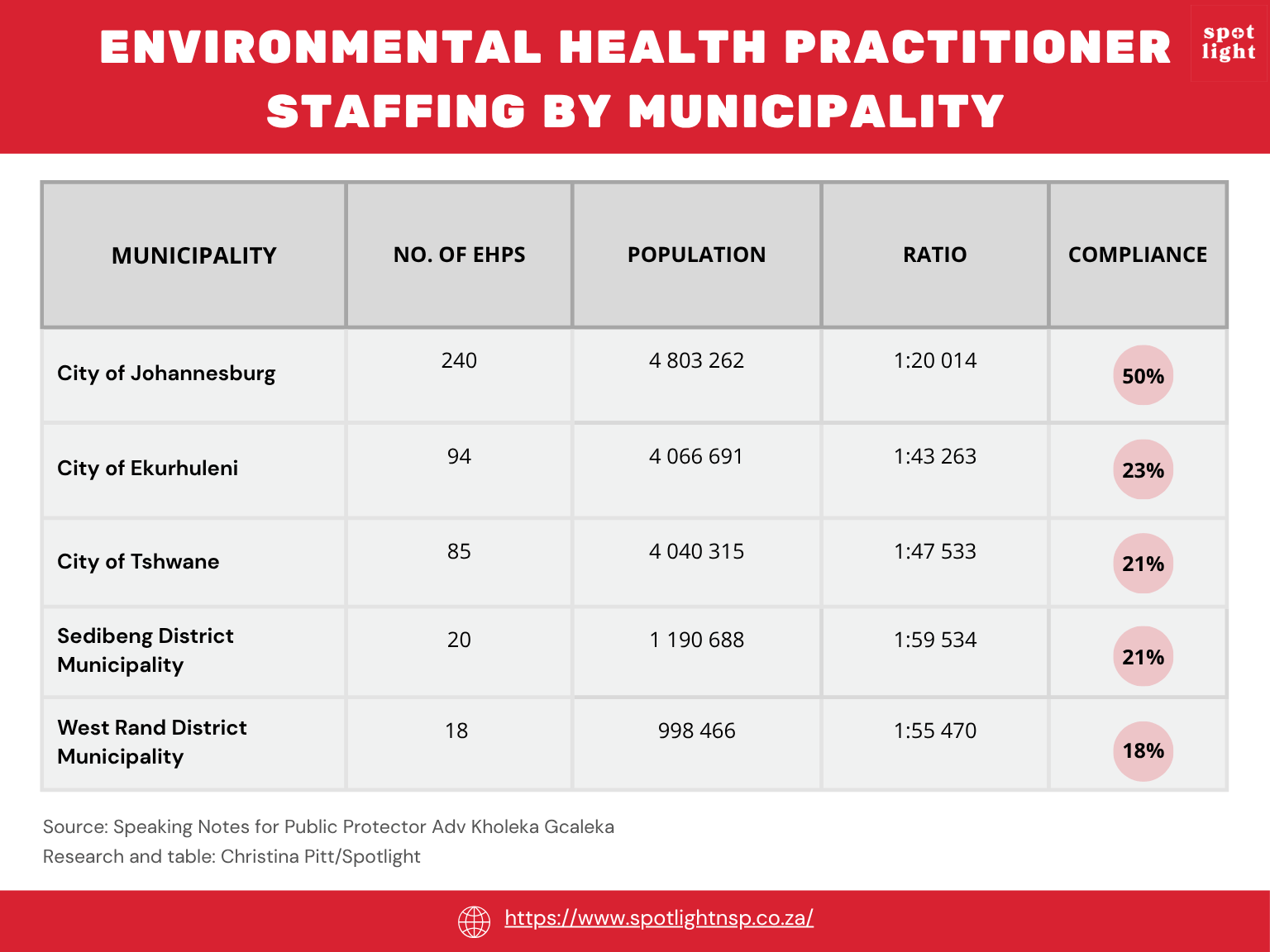
As of October 2025, every municipality fell short of the World Health Organisation (WHO) and the National Environmental Health Norms and Standards benchmark of one EHP for every 10 000 people.
Johannesburg had the largest absolute number of EHPs, with 240 practitioners serving a population of 4.8 million people. This gave it a ratio of one EHP for every 20 000 people, or 50% of the recommended benchmark.
Meanwhile, Ekurhuleni and Tshwane had fewer than one-quarter of the recommended number of EHPs.
According to City of Johannesburg spokesperson Nthatisi Modingoane, its current staffing complement is 213 EHPs, with eight funded vacancies. Despite ongoing recruitment, the City estimates that each EHP is still responsible for about 28 000 residents — almost three times the benchmark.
City of Ekurhuleni spokesperson Zweli Dlamini said the municipality now employs 98 EHPs, up from 94 during the Public Protector’s investigation. However, he acknowledged that the municipality still has a shortage of 309 EHP posts, leaving it well below the recommended staffing benchmark.
The City of Tshwane did not respond to Spotlight’s requests for updated staffing figures.
“The entire province is functioning at less than a third of the required EHP staffing capacity,” Gcaleka said about her findings, warning that the shortage threatens equitable access to environmental health services.
Anelich explained that staffing shortages are compounded by the breadth of EHPs’ responsibilities.
“EHPs are trained broadly, including water quality control and pollution monitoring — not only food,” she said.
“These people have multiple roles to play, which makes it very difficult for the system. We should have EHPs dedicated to food safety so municipalities can regulate food safety more effectively, particularly in the informal sector.”
The National Environmental Health Norms and Standards require EHPs to inspect high-risk food premises at least once every quarter. Maintaining those inspection frequencies becomes increasingly difficult when each practitioner is responsible for far more people than the recommended benchmark.
The capacity constraints extended beyond municipalities. The Public Protector found that the Department of Agriculture had filled only 27 inspector posts, which it described as insufficient to regulate agricultural pesticides effectively, weakening another part of the food safety chain.
But increasing staffing capacity depends on whether municipalities have the financial resources to create and sustain these posts.
Money troubles
The Public Protector also found that municipalities were not allocating enough funding to municipal health services, limiting their ability to recruit and retain EHPs.
Municipal health services are funded primarily through the local government equitable share. This is money allocated by National Treasury and transferred to municipalities to help provide basic services. Municipalities also use revenue from rates and taxes.
Because the equitable share is an unconditional grant, municipal councils decide how much funding is allocated to environmental health alongside their other constitutional responsibilities.
Related Posts
Although the National Department of Health is not responsible for funding municipal health services or employing EHPs, Mohale said it continues to support initiatives aimed at helping municipalities recruit, retain and train EHPs.
He also said the department engages with National Treasury and the Department of Cooperative Governance and Traditional Affairs to prioritise the appointment of EHPs and address staffing shortages.
The human cost
These system weaknesses had visible consequences on the ground. During blitz inspections cited by the Public Protector, EHPs repeatedly identified expired food, unlabelled products, poor hygiene, rodent infestations, and unsafe storage practices.
The Public Protector also found low levels of compliance with spaza shop licensing requirements.
Only 5% of spaza shops in Ekurhuleni were licensed or permitted, compared with 14% in Johannesburg and 30% in Tshwane, according to Gcaleka’s speaking notes. Across Gauteng, the compliance rate was 28%, meaning that for every licensed spaza shop, almost three were operating without the required license or permit.
“So many spaza shops aren’t licensed, so EHPs don’t even know where to look,” Anelich said.
“We can send EHPs into informal settlements to look for them, but that’s not a great use of resources that are already stretched.”
She also said the deaths highlighted what can happen when food safety systems fail. Adding that South Africa’s burden of foodborne disease remains poorly documented, making it difficult to understand the full scale of the problem.
A systemic failure
The Public Protector found that the problems extended beyond individual incidents.
In her speaking notes, Gcaleka says that the underlying governance weaknesses, severe staffing shortages, inadequate funding for municipal health services and capacity constraints in other parts of the food safety system were “not incidental, but systemic and far-reaching”.
She therefore made the preliminary finding that Johannesburg, Ekurhuleni, Tshwane, Sedibeng and West Rand had failed to properly enforce food safety and hygiene standards in the informal food sector.
As voters prepare to elect new local governments in November, the findings highlight a core municipal responsibility: preventing public health risks before they become public health crises.
